Structured Infrastructure Commodities: Expanding the Compute Thesis into a Basket
Core Thesis
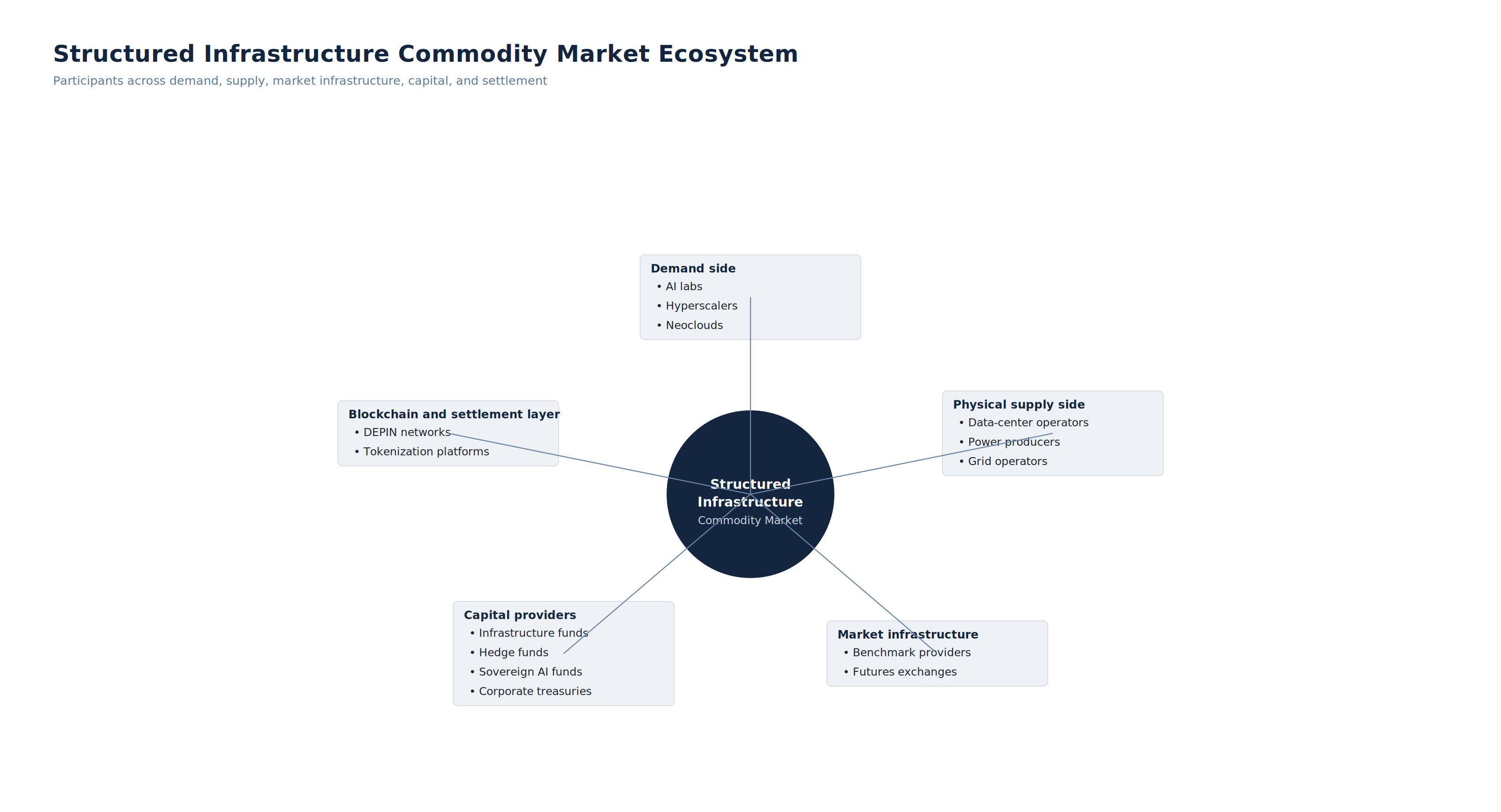
The next major asset class is not merely compute. It is structured infrastructure capacity.
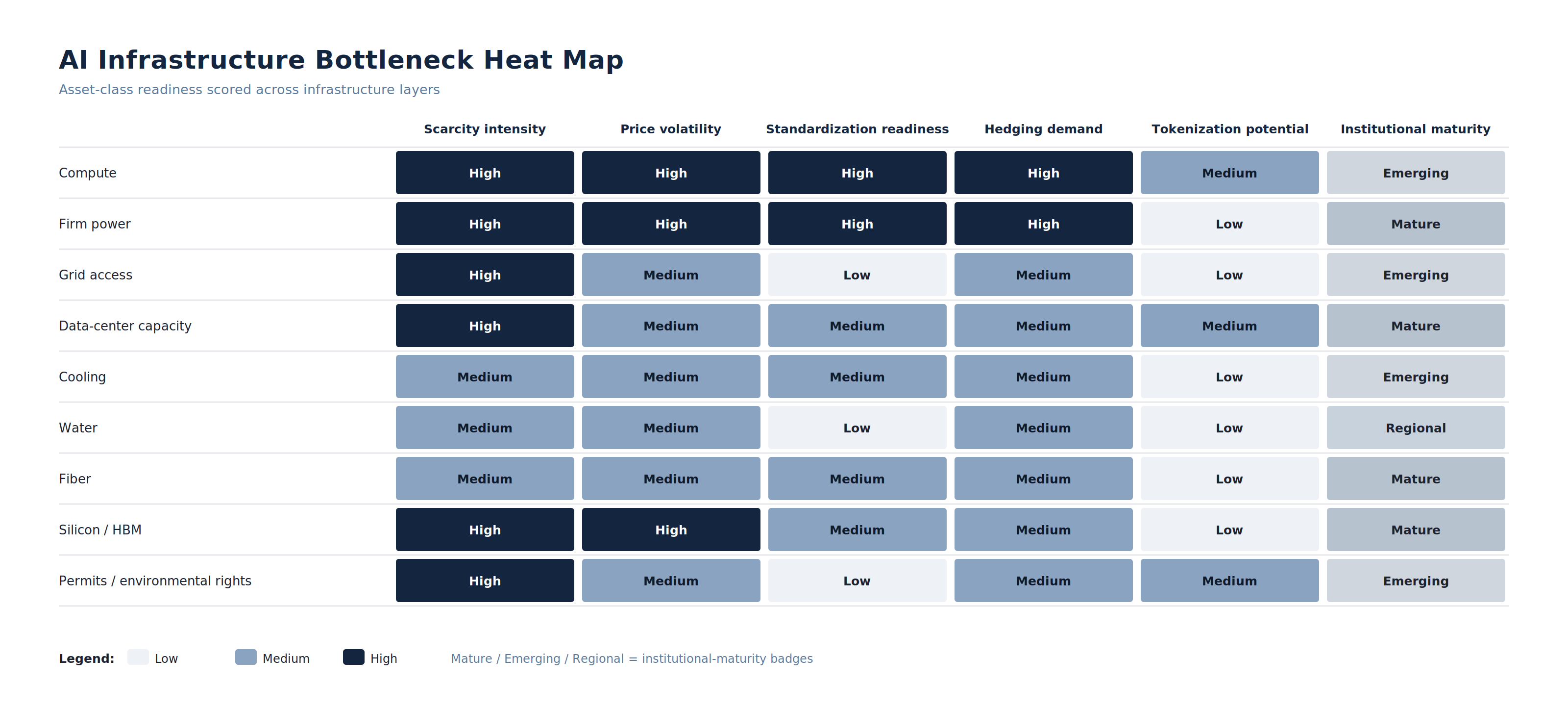
Compute is the first frontier because GPU-hours are becoming benchmarked, scarce, financeable and hedgeable sooner than the surrounding infrastructure layers. But the durable basket is broader: compute, firm power, grid deliverability, data-centre capacity, cooling, water, fibre, silicon supply and environmental permissions.
This category can be framed as:
Structured Infrastructure Commodities, or SICs.
A SIC is not a raw material like oil or copper, and it is not simply an equity claim on a company. It is a tradeable claim on constrained infrastructure throughput over time: GPU-hours, megawatt-months, rack-kilowatt capacity, transformer-backed grid access, cooling capacity, water availability, bandwidth, storage and related delivery rights.
Compute is the best current example because futures-market infrastructure is already being formed around it. CME and Silicon Data have announced plans for compute futures based on daily GPU rental-rate benchmarks, while ICE and Ornn have announced GPU compute futures based on Ornn’s Compute Price Index, which tracks live-traded spot prices for GPU compute across hardware types.
That means compute has moved from a private procurement input to an emerging benchmarked commodity.
1. Asset Class Definition
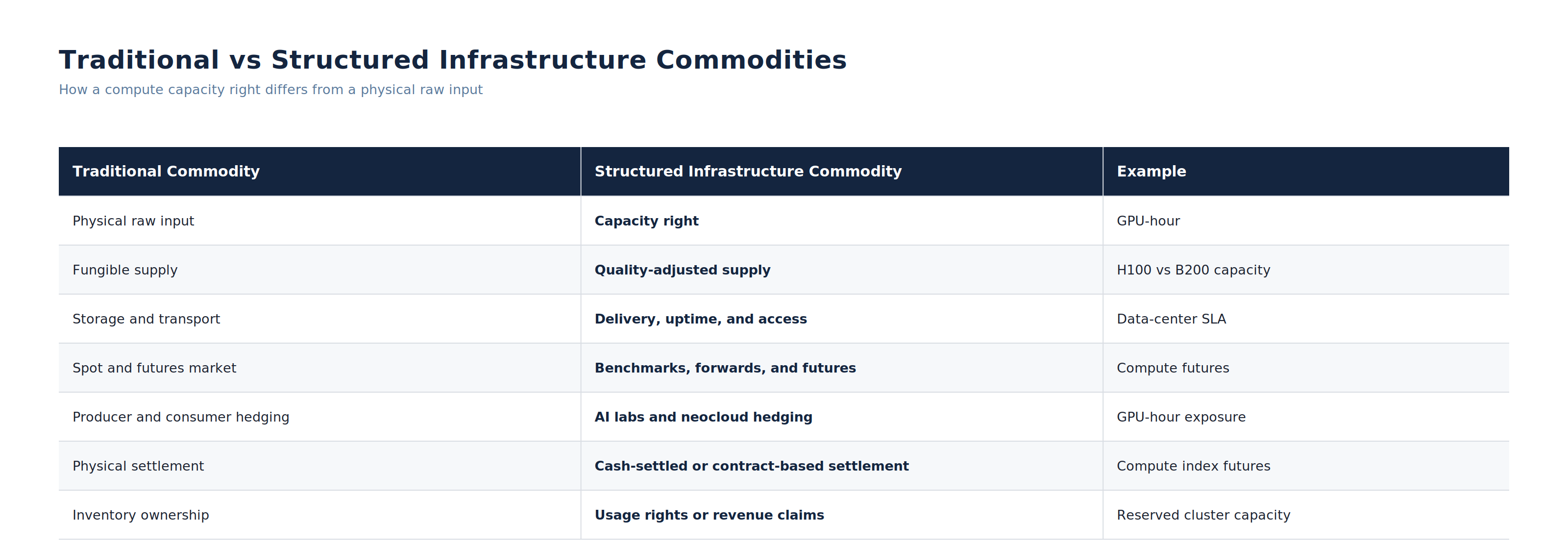
Structured Infrastructure Commodities are standardised, financialised claims on critical infrastructure bottlenecks.
They have five defining traits:
| Trait | Meaning |
|---|---|
| Physical constraint | Supply depends on real-world assets: chips, power, land, transformers, water, fibre, cooling and construction capacity. |
| Time-based utility | The asset is valuable because it delivers capacity during a specific period: GPU-hour, MW-month, rack-year, Gbps-mile. |
| Benchmarkable price | A reference price can be observed, indexed and eventually used for futures, swaps or structured notes. |
| Hedging demand | Buyers need to lock future costs; sellers need to lock future revenue. |
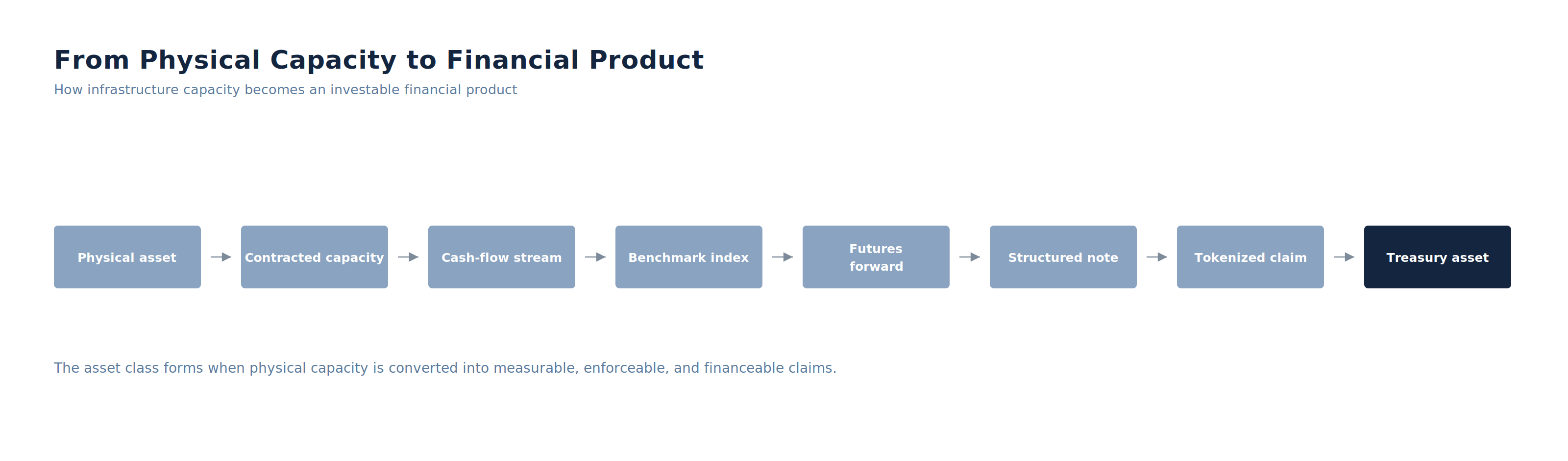
| Financial wrapper potential | Contracts can be securitised, tokenised, fractionalised or used as treasury reserves. |
The key insight is that the commodity is not always the physical object. The commodity is often the right to use constrained infrastructure at a future date.
That is why compute belongs in the same conceptual family as electricity, grid capacity, shipping slots, spectrum, emissions credits, data-centre leases and cloud reservations.
2. Why Compute Is the First Frontier
Compute leads the SIC category because it has the cleanest direct connection between AI demand and a measurable unit of output:
GPU capacity over time.
AI compute is becoming economically critical for foundation models, inference infrastructure, robotics, autonomous systems, quant research, simulation, biotech, defence, gaming, media generation and enterprise automation.
The demand curve is no longer just tied to software companies. It is tied to nearly every sector that needs intelligence, automation or prediction at scale.
This makes compute different from a normal cloud-service expense. It is becoming a scarce productive input.
The stronger version of the thesis is:
Compute is not just a technology resource. It is becoming a priced claim on AI production capacity.
Compute is also easier to benchmark than many other infrastructure constraints. A contract can reference a specific GPU class, such as H100, H200, B200 or equivalent accelerator capacity, over a defined period.
This makes it possible to create:
- GPU-hour indices
- Compute futures
- Forward compute contracts
- OTC compute swaps
- Tokenised compute claims
- Compute-backed debt
- Compute treasury reserves
That is why compute is the first frontier of the broader SIC asset class.
3. The Basket: AI Structured Infrastructure Commodity Basket
An expanded basket could be called the:
AI Infrastructure Capacity Basket, or AICB.
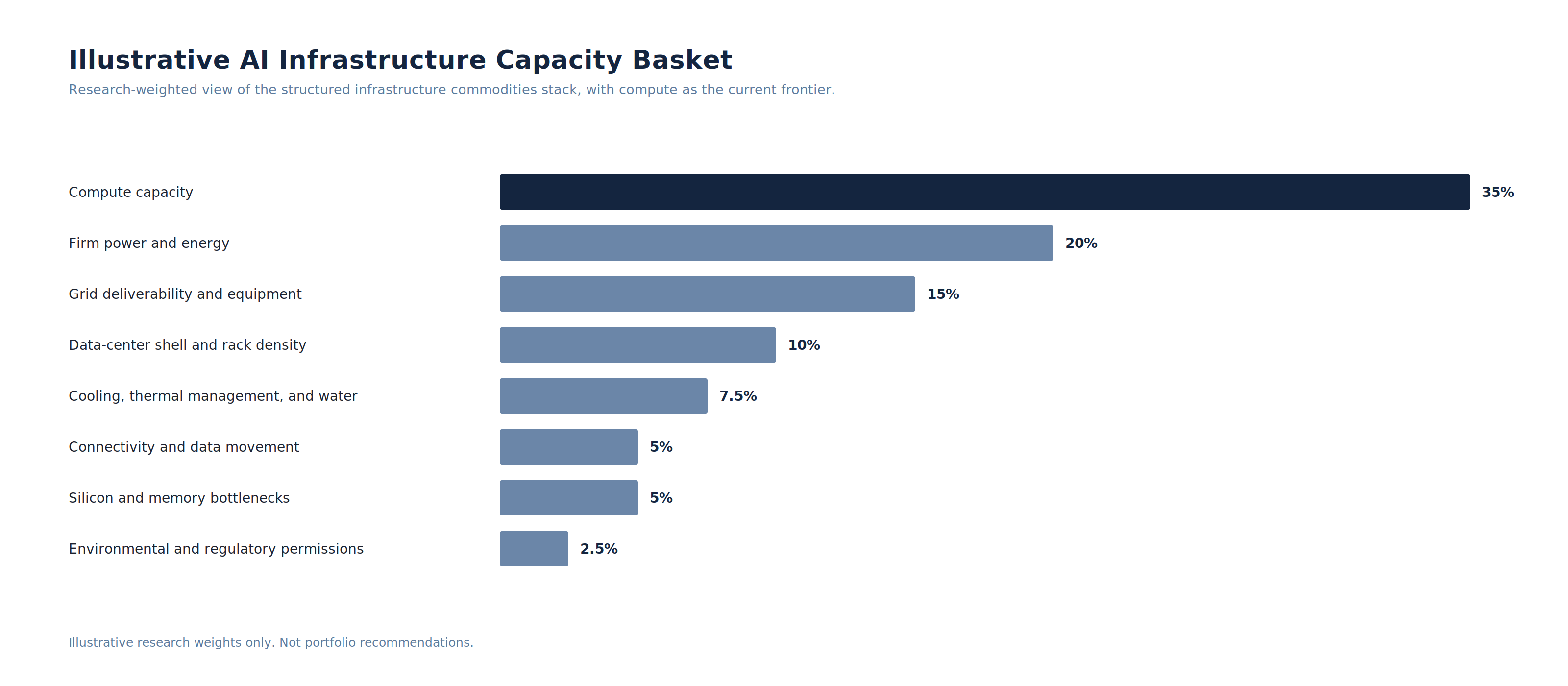
These are not recommended portfolio weights. They are research weights for defining the asset class.
| Sleeve | Illustrative Weight | Commodity Unit | Economic Role | Near-Term Expression |
|---|---|---|---|---|
| 1. Compute capacity | 35% | GPU-hour, accelerator-hour, inference-token capacity, reserved cluster capacity | Core AI production unit. This is the most direct expression of AI infrastructure scarcity. | Compute futures, OTC GPU swaps, reserved cloud-capacity contracts, DePIN compute markets. |
| 2. Firm power and energy | 20% | MWh, MW-month, PPA strip, gas/nuclear/renewable generation capacity | Compute cannot clear without power. The true scarce input may be firm power at the right node. | Power futures, nodal power exposure, PPAs, capacity markets, gas/power spreads, nuclear/renewable firming contracts. |
| 3. Grid deliverability and equipment | 15% | Transformer capacity, UPS capacity, substation access, interconnection rights | Converts theoretical electricity into usable data-centre power. A major hidden bottleneck. | Infrastructure funds, project finance, equipment-linked exposure, grid-access premiums, future interconnection-right markets. |
| 4. Data-centre shell and rack density | 10% | Leased MW, rack-kW, data-centre availability-zone capacity, uptime-adjusted capacity | Turns chips and power into usable compute environments. Location and density create scarcity. | Data-centre leases, REITs, private infrastructure funds, capacity prepayments, regional rack-MW forwards. |
| 5. Cooling, thermal management and water | 7.5% | kW cooled, gallons/MWh, water-use efficiency, liquid-cooling capacity | Enables high-density AI clusters. Becomes more important as rack density rises. | Cooling infrastructure, water rights, water-efficient facility exposure, thermal equipment, closed-loop cooling systems. |
| 6. Connectivity and data movement | 5% | Gbps-mile, fibre route-mile, optical port capacity, latency-adjusted bandwidth | AI training and inference both require fast data movement. Low-latency fibre becomes part of the compute supply chain. | Fibre IRUs, bandwidth contracts, optical networking exposure, data-centre interconnects. |
| 7. Silicon and memory bottlenecks | 5% | GPU units, HBM capacity, advanced packaging capacity, wafer starts | Upstream supply constraint. Determines how quickly new compute supply can come online. | Semiconductor supply contracts, advanced packaging exposure, HBM/memory exposure, equipment suppliers. |
| 8. Environmental and regulatory permissions | 2.5% | RECs, carbon credits, water permits, heat-reuse credits, emissions intensity | The licence-to-operate layer. Becomes more valuable where data-centre backlash grows. | Renewable-energy credits, carbon markets, water permits, regulated site premiums. |
The strongest version of the basket is not “long every AI stock.” It is a multi-layer scarcity basket around the infrastructure stack required to produce AI compute.
4. Why Each Sleeve Belongs in the Same Asset Class
4.1 Compute Capacity: The Benchmark Layer
Compute is the cleanest first contract because the unit is intuitive:
a specific GPU or accelerator available for a specific period.
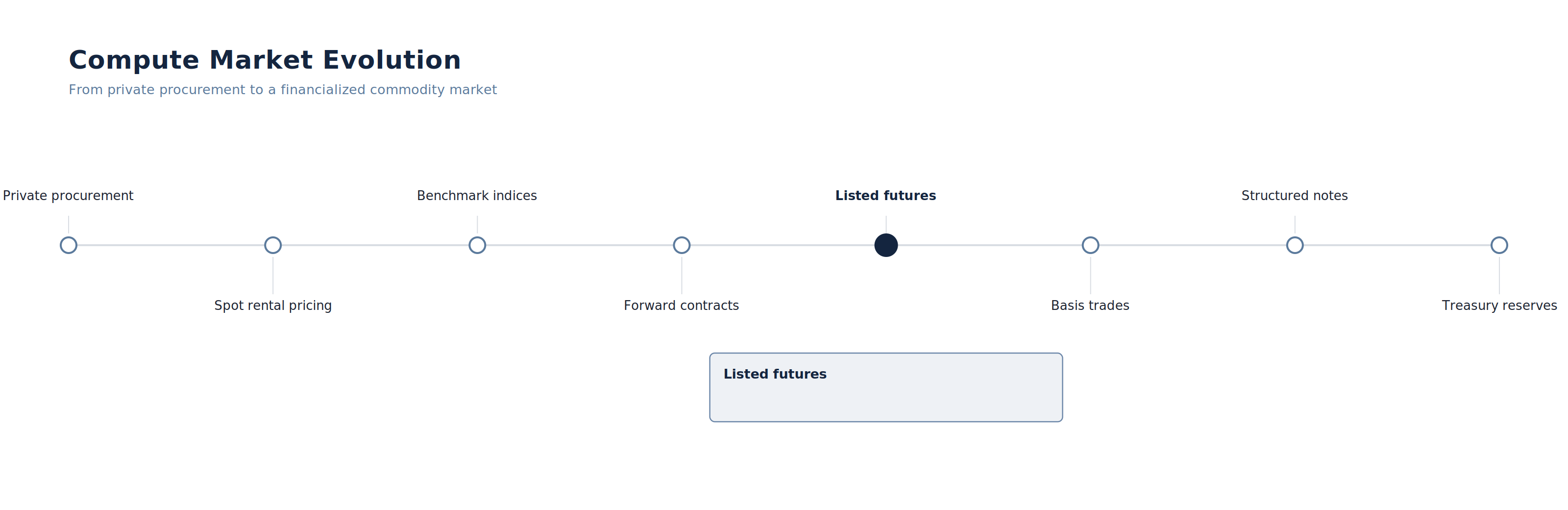
This is exactly how commodity markets begin to financialise:
- Benchmarks emerge.
- Forward markets develop.
- Futures are listed.
- Liquidity grows.
- Structured products follow.
Compute is moving into this sequence now.
4.2 Power: The Shadow Commodity Beneath Compute
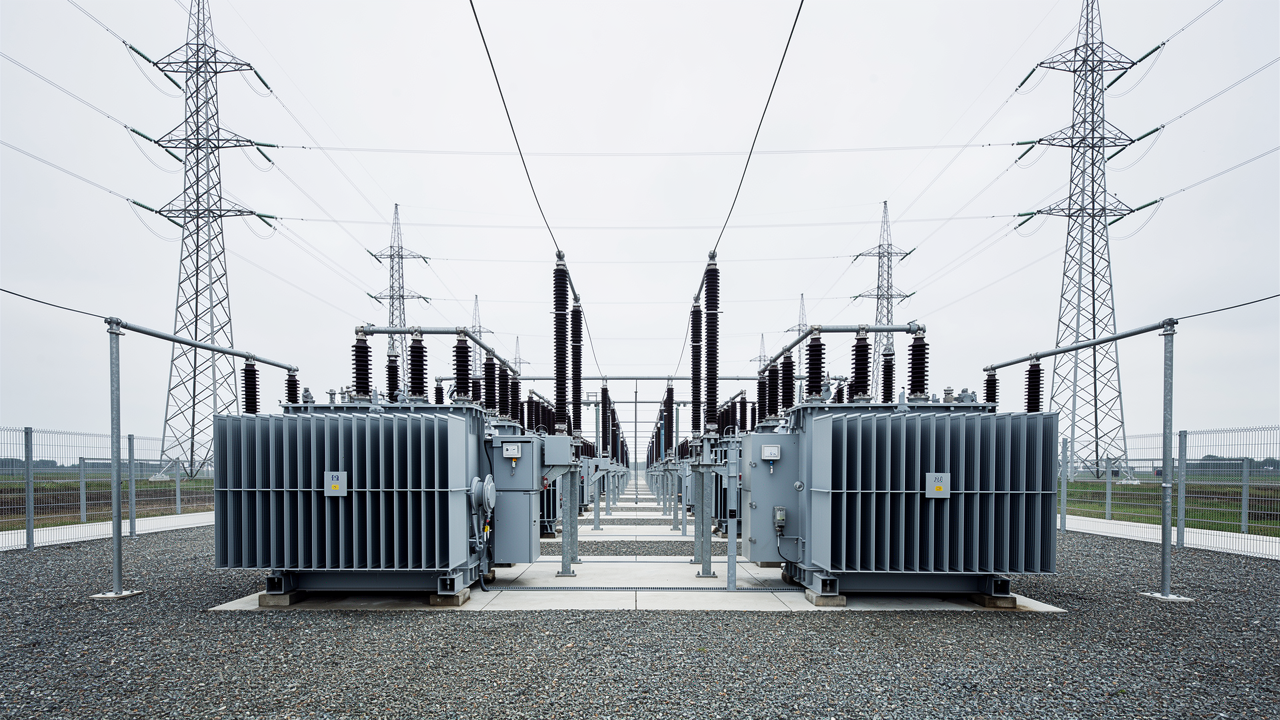
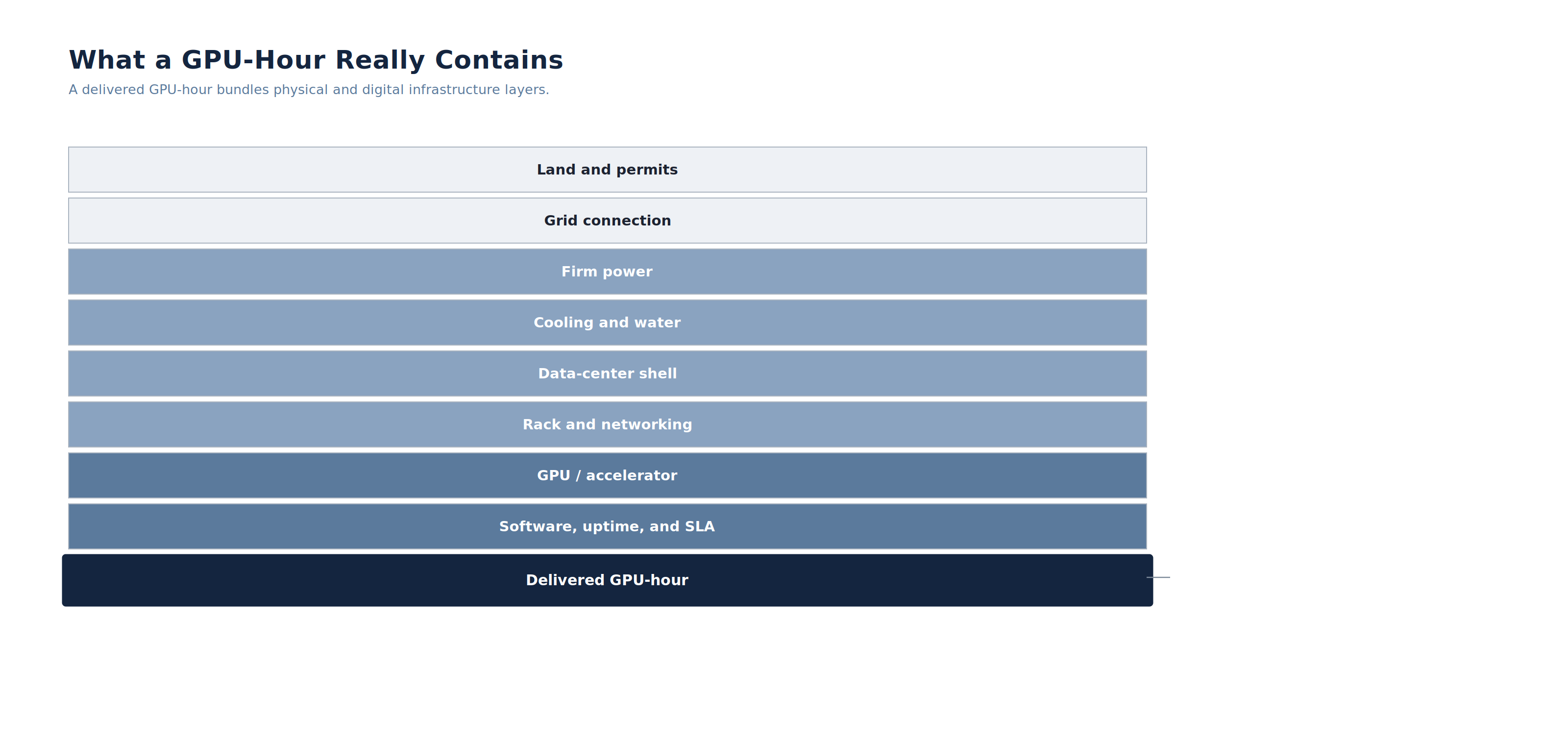
A GPU-hour is only useful if it has power.
Power is the embedded cost curve under compute. The more AI workloads scale, the more compute pricing becomes connected to electricity availability, grid access and the cost of firm energy.
This means the basket should not be purely digital. Compute is the visible commodity, but firm power is the underlying constraint.
4.3 Grid Deliverability: The Hidden Bottleneck
Power supply alone does not solve the problem. The power must be delivered, conditioned and made reliable enough for hyperscale compute.
The critical bottlenecks include:
- Transformers
- Substations
- Interconnection queues
- UPS systems
- Switchgear
- Transmission capacity
- Local grid reliability
This is why the basket needs a grid-equipment and interconnection sleeve.
The highest-value asset may become not electricity in the abstract, but deliverable electricity at a specific node with sufficient transformers, UPS, substations and permits.
4.4 Data-Centre Capacity: The Real-Estate Wrapper
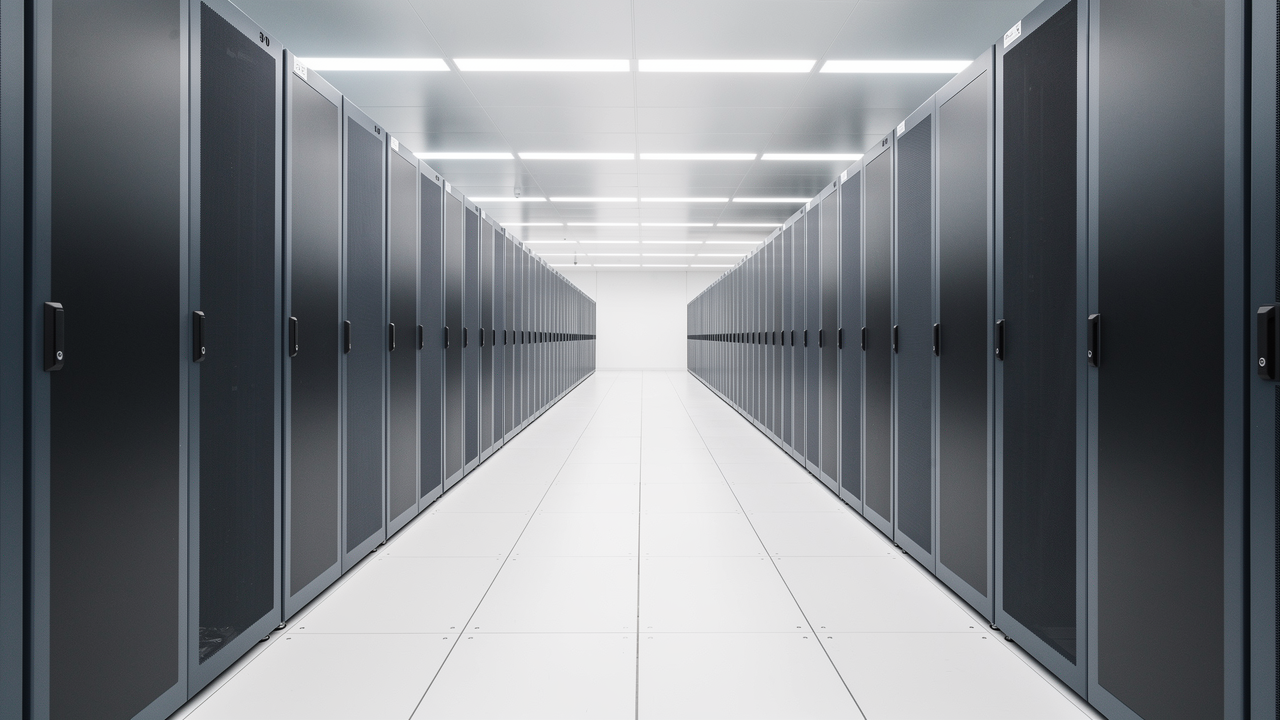
Data centres are the physical factory floor for compute.
But unlike generic real estate, the commodity-like unit is not square footage. It is:
available, powered, cooled, networked rack capacity.
A future market could evolve around leased MW capacity by region, rack density, uptime class and cooling type.
This is where the asset class starts to look like a hybrid of power, logistics, cloud infrastructure and industrial real estate.
4.5 Cooling and Water: The Density Enablers
AI servers are denser, hotter and more power-intensive than legacy workloads.
Cooling and water are no longer side issues. They are density enablers.
The more AI clusters move toward high-density rack architectures, the more valuable liquid cooling, closed-loop cooling and water-efficient facility design become.
This makes cooling capacity a valid part of the SIC basket.
4.6 Fibre and Connectivity: The Transportation Layer
If compute is the refinery, fibre is part of the pipeline network.
AI workloads require fast data movement across:
- Training clusters
- Data centres
- Inference endpoints
- Enterprise environments
- Edge compute nodes
- Cloud regions
Bandwidth can therefore become a structured infrastructure commodity: route-specific, time-specific and latency-adjusted data movement.
4.7 Silicon and Memory: The Upstream Supply Constraint
GPU supply depends on deeper semiconductor constraints:
- Advanced nodes
- HBM memory
- Packaging capacity
- Foundry capacity
- Substrate supply
- Equipment availability
This sleeve captures the upstream bottleneck that determines how quickly new compute supply can come online.
4.8 Environmental and Regulatory Permissions: The Licence-to-Operate Layer
The more data centres stress local grids, water systems and land-use policy, the more valuable permissions become.
This includes:
- Renewable-energy credits
- Carbon credits
- Water permits
- Heat-reuse credits
- Environmental approvals
- Local zoning approvals
- Emissions-intensity compliance
In constrained regions, the permission to operate may become a scarce asset in itself.
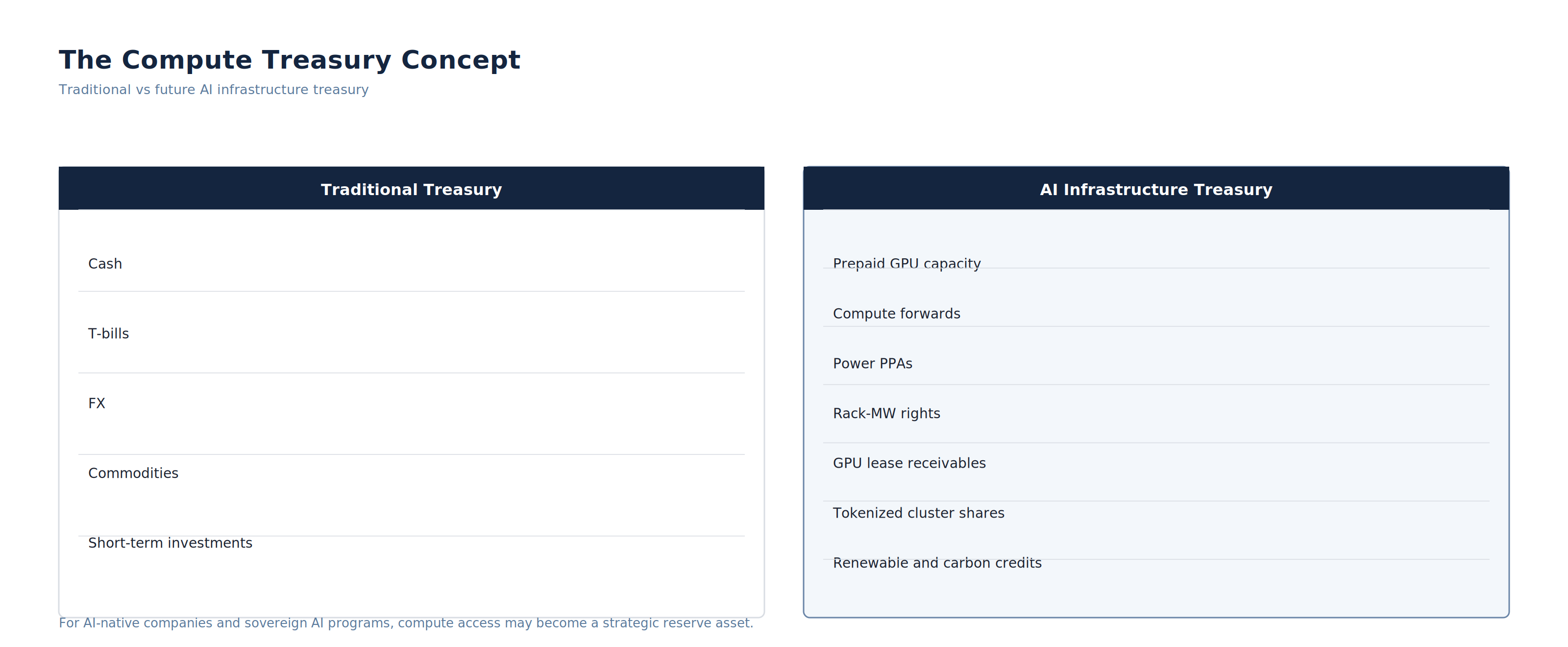
5. The Compute Treasury Concept
The treasury point becomes stronger when expanded beyond server ownership.
A future AI-native treasury could hold a reserve of:
| Treasury Reserve Asset | Purpose |
|---|---|
| Prepaid GPU capacity | Hedge future training or inference costs. |
| Forward compute contracts | Lock supply before market tightness. |
| GPU lease receivables | Turn compute revenue into financeable cash flows. |
| Tokenised server or cluster shares | Fractionalise ownership or revenue participation. |
| Power PPAs | Secure energy cost and availability. |
| Grid/interconnection rights | Preserve future expansion optionality. |
| Water/cooling rights | Protect thermal capacity in constrained regions. |
| Carbon/renewable credits | Preserve licence to operate and ESG compliance. |
For an AI company, a compute treasury could become as important as a fuel hedge is for an airline.
For a sovereign AI programme, compute reserves could become strategic infrastructure.
For a DePIN network, tokenised compute reserves could become the balance-sheet base layer.
The institutional version is likely to start with traditional contracts: PPAs, leases, GPU financing, project finance and OTC hedges.
The crypto-native version is more likely to develop around tokenised claims on server revenue, GPU-hour delivery rights or compute-backed treasury tokens.
6. The Structured Product Form
A mature version of this market could support several products.
6.1 Compute Futures
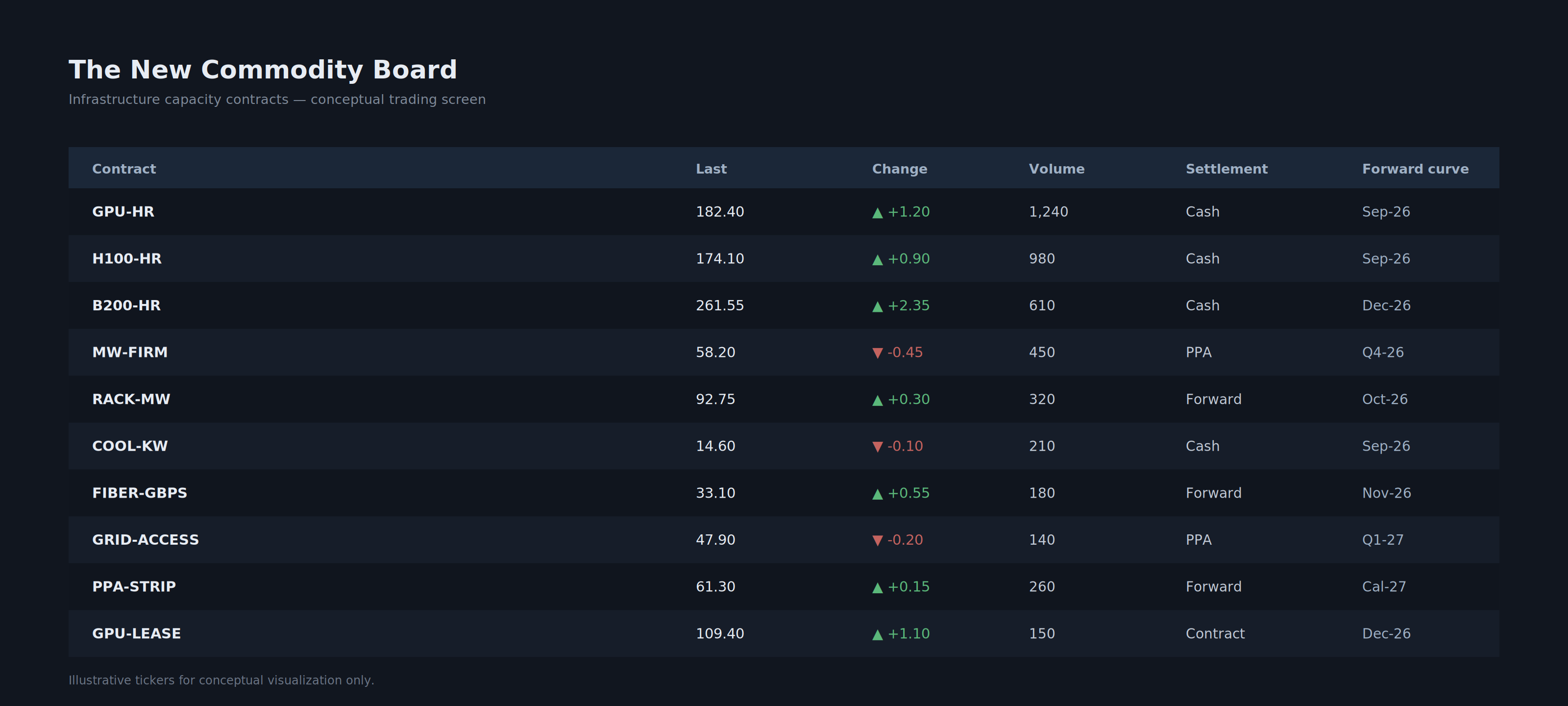
The first listed contracts are likely to be cash-settled GPU-hour futures by chip class:
- H100
- H200
- B200
- MI300X
- Future accelerator equivalents
Cash settlement is likely because physical delivery of compute is complex. Delivery quality depends on:
- Uptime
- Identity and access control
- Software stack
- Region
- Security
- Latency
- Data-transfer requirements
- Cluster topology
- Networking
- Support levels
6.2 Compute-Power Spreads
Once compute futures trade, the natural spread is:
GPU-hour revenue minus electricity cost.
This creates an AI version of spark spreads in power markets.
A neocloud or data-centre operator could hedge GPU rental revenue while also hedging the power cost needed to deliver that compute.
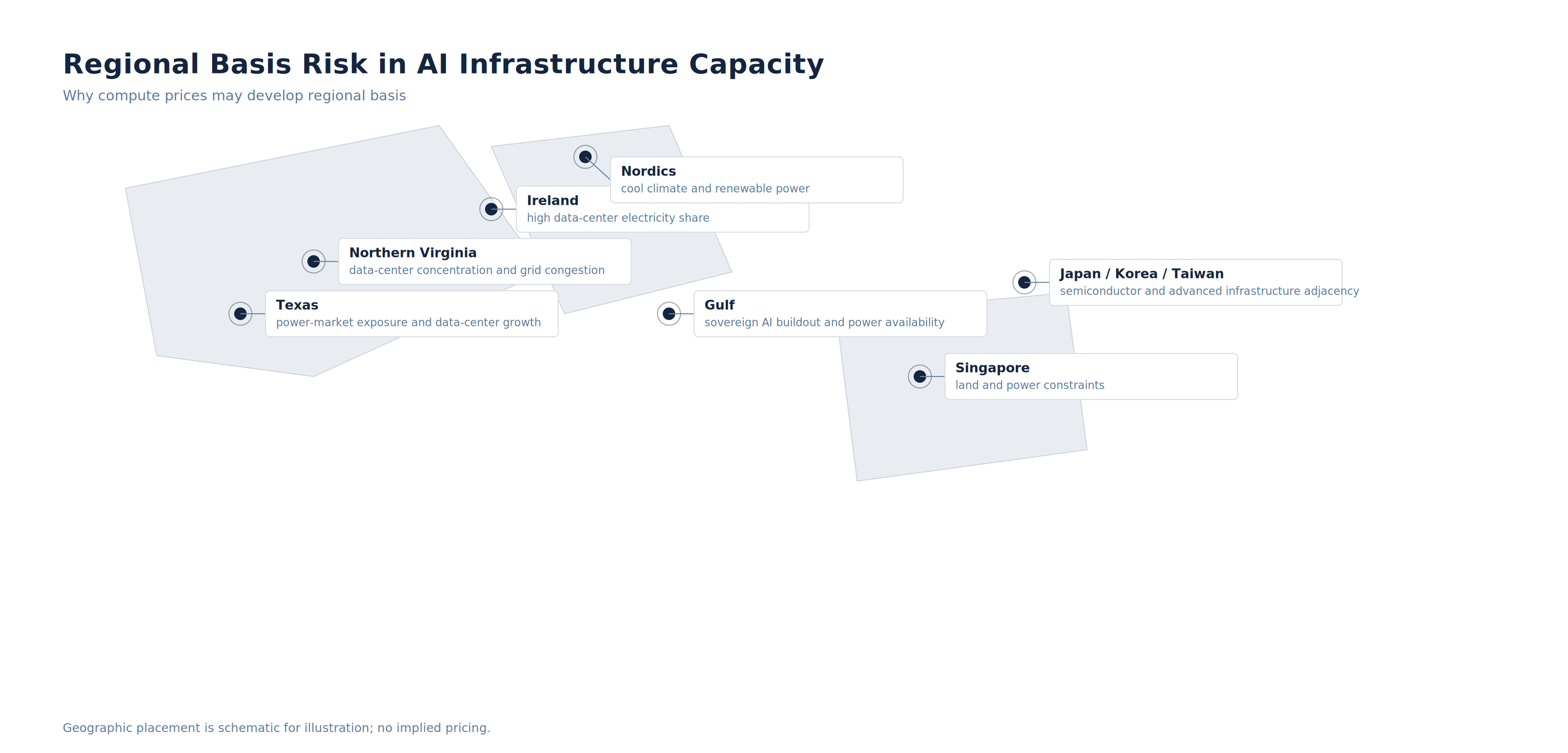
6.3 Regional Compute Basis
Compute will not be perfectly fungible.
A GPU-hour in a power-constrained region with expensive electricity and grid queues is not the same as a GPU-hour near cheap power, fibre and permissive regulation.
Regional basis markets could develop around locations such as:
- Northern Virginia
- Texas
- The Nordics
- Ireland
- Singapore
- The Gulf
- Japan
- Other AI infrastructure hubs
6.4 Rack-MW Forwards
Data-centre operators and AI labs could trade future claims on powered, cooled rack capacity.
These would look like real-estate leases, power contracts and cloud-reservation agreements blended into one capacity instrument.
6.5 Tokenised Compute Notes
A tokenised compute note could represent:
- Fractional ownership of a GPU cluster
- A claim on future GPU rental revenue
- A prepaid right to consume compute
- A compute-backed treasury instrument
- A yield-bearing claim on deployed server capacity
This is plausible, but it will need:
- Strong legal documentation
- Custody and maintenance rules
- Insurance
- Hardware audits
- Revenue verification
- Bankruptcy remoteness
- Securities-law clarity
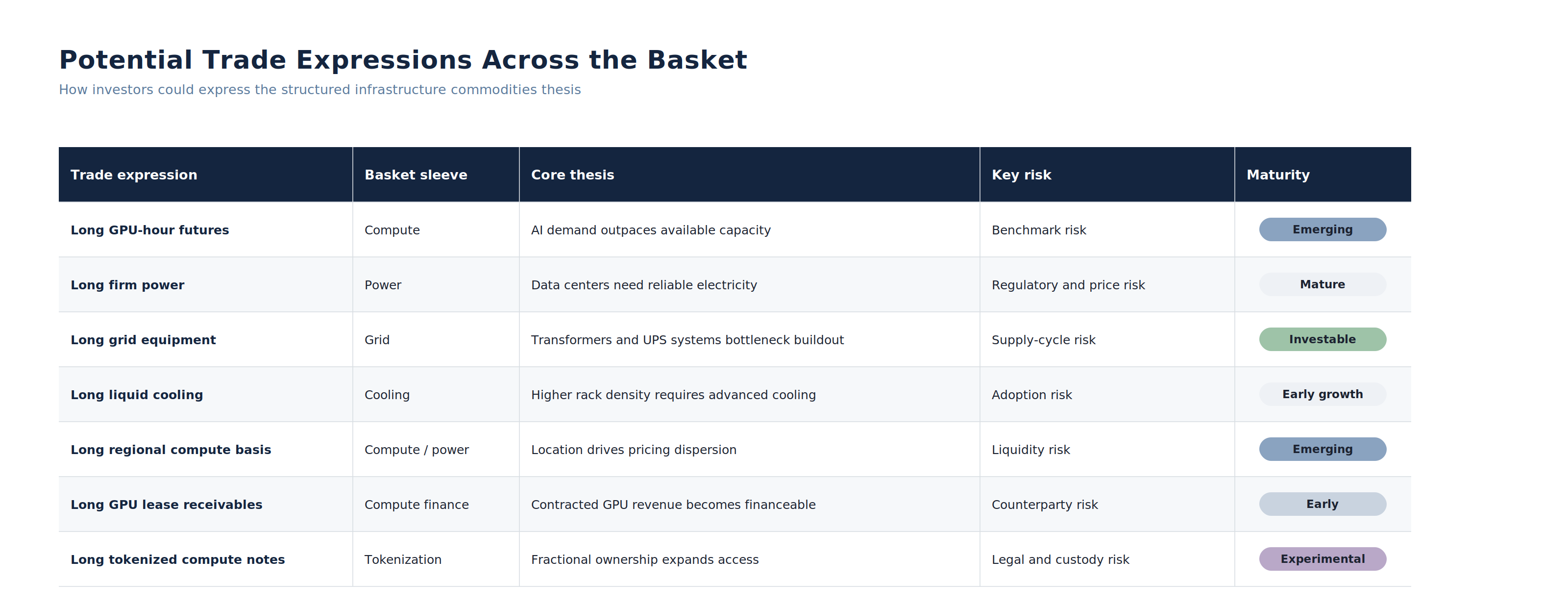
7. Key Trade Expressions
The thesis creates multiple trade expressions rather than one single long.
| Trade Expression | Thesis |
|---|---|
| Long compute scarcity | GPU rental prices and capacity premia rise when AI demand outpaces supply. |
| Long firm power vs generic power | AI loads reward electricity that is reliable, local and immediately deliverable. |
| Long grid bottlenecks | Transformers, UPS systems and interconnection rights become gating assets. |
| Long liquid cooling / short legacy cooling | Higher rack density favours facilities that can cool next-generation accelerators. |
| Long regional basis volatility | Compute prices diverge by location as power, regulation and fibre constraints differ. |
| Long new accelerator capacity / short obsolete GPU capacity | Hardware cycles create relative-value trades across chip generations. |
| Long tokenised capacity optionality | Fractional ownership and programmable settlement may expand access, but this is higher risk and earlier stage. |
The best formulation is not simply “compute prices go up.”
The better thesis is:
AI demand will create persistent bottleneck premia across the physical infrastructure stack, and compute will be the most visible, liquid and benchmarked expression of that broader scarcity.
8. Risks and Challenges
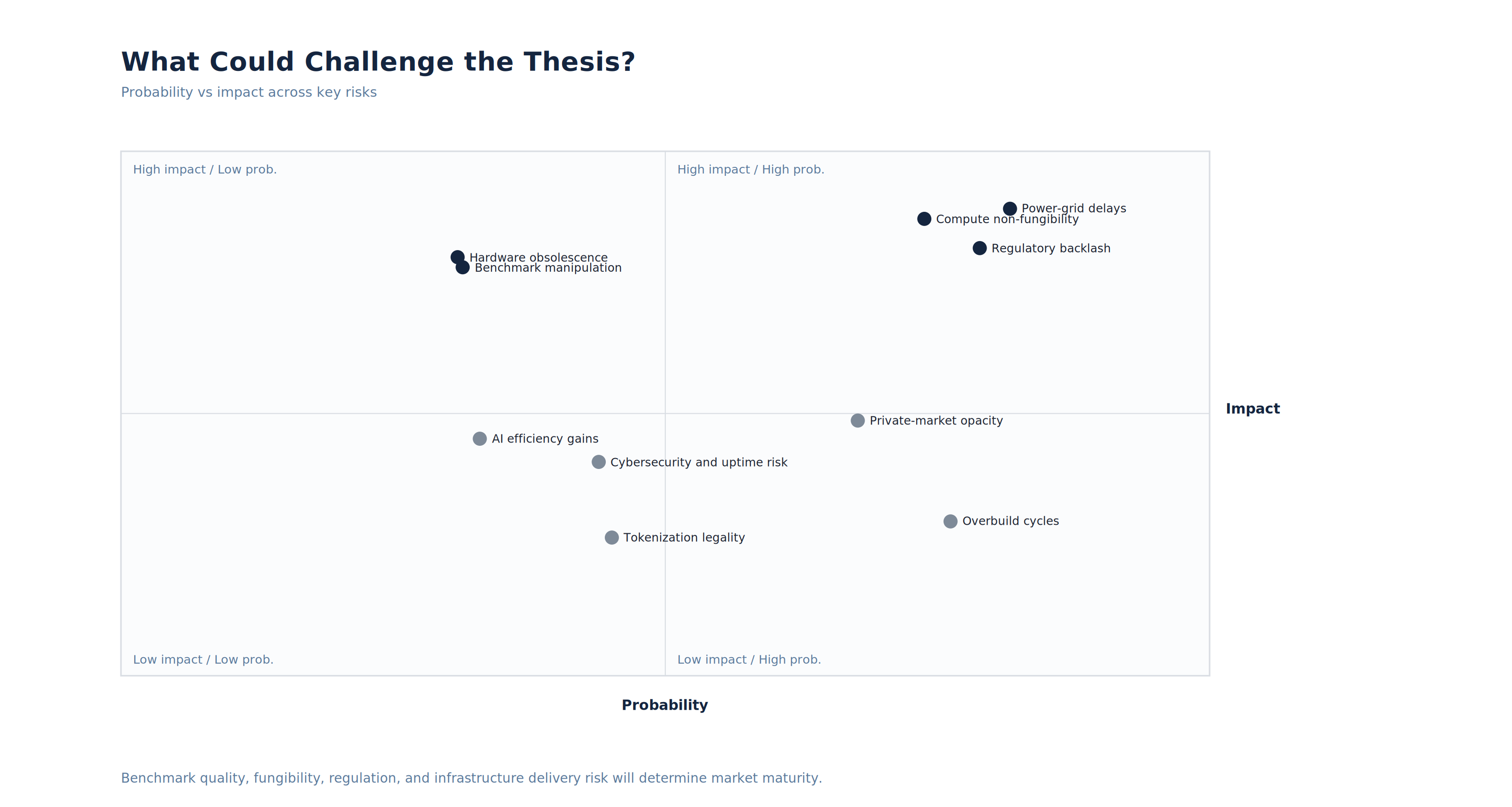
The asset class is real, but the thesis should still be challenged.
8.1 Compute Is Not Fully Fungible
Chip type, interconnect, memory, uptime, region, security, software stack and latency all matter.
This makes compute more like electricity, freight or bandwidth than crude oil.
8.2 Benchmarks Are Fragile
If GPU pricing data is too thin, private, self-reported or dominated by a few platforms, futures markets may struggle to build trust.
The success of compute futures depends on trusted reference prices.
8.3 Efficiency Can Cut Both Ways
Better models and cheaper inference can increase demand through Jevons paradox, but they can also reduce the need for some capacity or cause overbuild in older GPU generations.
8.4 Regulation Is Becoming a Real Constraint
Data-centre expansion is becoming a political and environmental issue in regions where power use, water use, utility bills and grid reliability are under pressure.
Regulatory permission may become one of the most important scarcity layers.
8.5 Tokenisation May Arrive Later Than Futures
Fractionalised server ownership is plausible, but institutional capital will demand:
- Regulated custody
- Enforceable cash-flow rights
- Clear claims on assets
- Cyber insurance
- Hardware auditability
- Bankruptcy protection
- Liquidity
Tokenisation can be powerful, but it may follow the benchmark and futures layer rather than lead it.
9. Final Thesis Formulation
Compute is the first major frontier of a broader Structured Infrastructure Commodity asset class. AI is turning infrastructure capacity into a financial asset: GPU-hours, firm power, grid access, data-centre rack density, cooling, water, fibre and silicon supply are becoming measurable, scarce and financeable. Compute will likely be the first liquid expression because benchmarks and futures are already emerging, but the superior basket is a multi-layer AI infrastructure capacity basket that captures the entire bottleneck stack.
Even more simply:
Compute is the oil. Power is the fuel. Grid access is the pipeline. Cooling is the refinery constraint. Fibre is the transport network. Tokenisation is the ownership wrapper. The asset class is structured infrastructure capacity.
10. Strategic Implication
This creates a frontier asset class for investors, infrastructure operators, protocols, AI companies and treasuries.
The opportunity is not only to trade compute. The opportunity is to define, benchmark and structure the entire AI infrastructure bottleneck stack.
The winning market participants will not only own GPUs. They will control or hedge the scarce inputs that make compute deliverable:
- Power
- Grid access
- Data-centre capacity
- Cooling
- Fibre
- Silicon supply
- Environmental permissions
- Financial wrappers
Compute is the entry point. Structured infrastructure capacity is the full asset class.